
Your biggest distractions probably look like work.

Why lack of clarity, weak ownership and overloaded capacity make avoidance easier than action
Most distractions do not look like distractions.
They look like work.
Answering email. Fixing a spreadsheet. Helping someone with a problem. Researching something interesting. Tidying a process. Joining another meeting.
All useful things.
And sometimes, all very effective ways of avoiding the thing that matters more.
I have seen this pattern repeatedly with leaders and managers.
Someone knows they need to redesign how they use their calendar, but keeps putting off creating the new rhythm.
Someone knows they need to delegate something, but keeps stepping back into the work.
Someone has an important piece of thinking to do, but finds ten smaller things to finish first.
By the end of the day, they have been busy.
Possibly very busy.
But the important thing has barely moved.
Distraction is not always a discipline problem
The obvious response is to focus on productivity.
Turn off notifications.
Block out the calendar.
Put the phone away.
Stop checking email.
Those things can help.
But they often treat the symptom rather than the cause.
Because distraction frequently starts somewhere further upstream.
It starts with a lack of clarity.
When we are not clear about what needs to happen, the work becomes harder to enter.
The task might be too broad.
The next step might be unclear.
We may not know what good looks like.
We might not even be sure whether the work is really ours to do.
And from there, a fairly predictable chain begins.
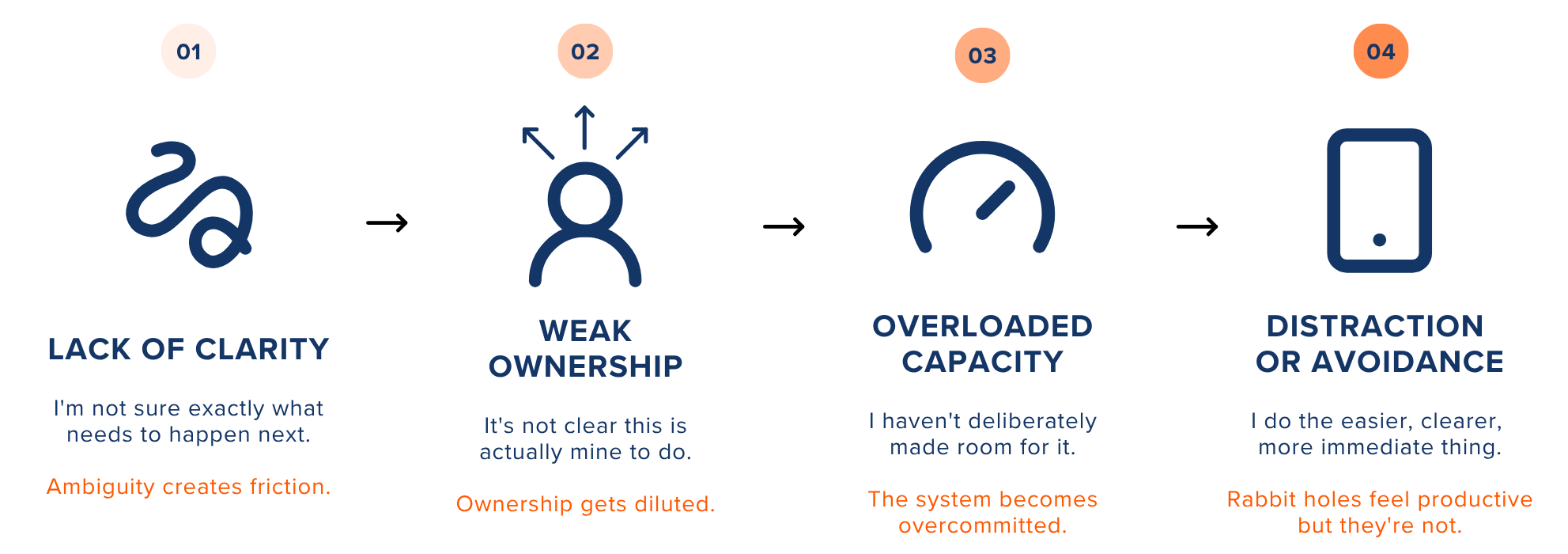
1. Lack of clarity creates friction
A vague task is surprisingly difficult to start.
“Work on the strategy.”
“Fix the team structure.”
“Improve communication.”
“Delegate more.”
These may be important priorities, but they do not tell us what to do next.
And when the next step is unclear, something else usually wins.
Email is easy to enter.
A colleague asks a question. We answer it.
A problem appears. We solve it.
A request comes in. We respond.
The smaller work wins because it is clearer.
So the first question is simple:
Clarity: Do I know exactly what needs to happen next?
Not eventually.
Next.
The clearer the next action, the less room there is for friction.
2. Weak ownership creates drag
The next problem is whether the work is actually ours.
Leaders often carry work they should no longer own.
Sometimes because delegation has been unclear.
Sometimes because someone else has not fully taken responsibility.
Sometimes because the leader does not trust the work will be done well enough.
And sometimes because doing it ourselves feels easier than resolving the ownership question.
That creates a subtle form of overload.
We start carrying work that belongs partly, or entirely, somewhere else.
Then we experience a capacity problem.
But the real issue may have started with ownership.
So the second question is:
Ownership: Is this actually mine to do?
Not:
Can I do it?
Would I do it better?
Could I get it done faster?
Is it actually mine?
That is a harder question.
And often a more useful one.
3. Overloaded capacity leaves no room for important work
Even when the work is clear and the ownership is right, it still needs somewhere to live.
Important work rarely fits neatly into the gaps between meetings.
Thinking requires space.
Difficult conversations require preparation.
Design work requires concentration.
Leadership requires time that has not already been consumed by everything else.
If the calendar is full, the important task becomes something we will get to “when things settle down.”
They usually do not.
So the third question is:
Capacity: Have I deliberately made room for it?
If something matters, it needs capacity assigned to it.
Not hoped for.
Assigned.
4. Then comes distraction
Once clarity, ownership and capacity start to break down, distraction becomes much easier.
And this is where the rabbit holes appear.
The brain is effectively choosing between two kinds of work.
One is unclear, difficult, uncomfortable, political, boring or mentally demanding.
The other is concrete, solvable and immediately rewarding.
It is not difficult to see which one often wins.
That is why productive people can be especially good at avoiding important work.
They do not stop working.
They simply move toward work that feels easier to complete.
That is a much harder form of distraction to notice.
Because it still feels productive.
Look upstream before you blame focus
This is why I am increasingly wary of treating distraction as purely a self-discipline problem.
Sometimes it is.
Sometimes we do simply need to put the phone away and get on with it.
But sometimes the more useful response is to look further upstream.
Ask:
Clarity: Do I know exactly what needs to happen next?
Ownership: Is this actually mine to do?
Capacity: Have I deliberately made room for it?
If one of those is missing, the distraction may be telling you something important.
The browser tab is probably not the real problem.
The inbox may not be the real problem.
The sudden urge to reorganise something may not be the real problem.
They may simply be the escape route.
The better question is:
What are you repeatedly distracting yourself from?
And then:
What does that tell you about the clarity, ownership or capacity surrounding the work?
Dan.